User Guide
Every screen in Stilo, with the buttons, icons and display areas explained one by one. If something on screen is unclear, open the section for the screen you are looking at.
Contents
1. How Stilo thinks about your files
Stilo never imports your documents into a library of its own. It opens the .md files already visible in the Files app, whether they sit On My iPhone, in iCloud Drive, or on a service such as Dropbox or OneDrive, and it saves them back to the same place.
Because of that, other apps can open the very same files, and deleting Stilo leaves your writing untouched. The flip side is that Stilo has no document list of its own: finding a file works exactly as it does in Files.
Saving is automatic. Your work is written to disk shortly after you stop typing, and again when you close the file. There is no save button.
2. Opening and creating files
Launching the app shows a screen much like the Files app. This is the document browser provided by iOS, not a list Stilo maintains.
The first launch can take a moment before the list is complete. iOS is asking iCloud Drive and any other cloud services for their contents and assembling the list of locations; Stilo is not loading your documents. The more services you are signed in to, and the slower the connection, the longer it takes. Later launches are quicker.
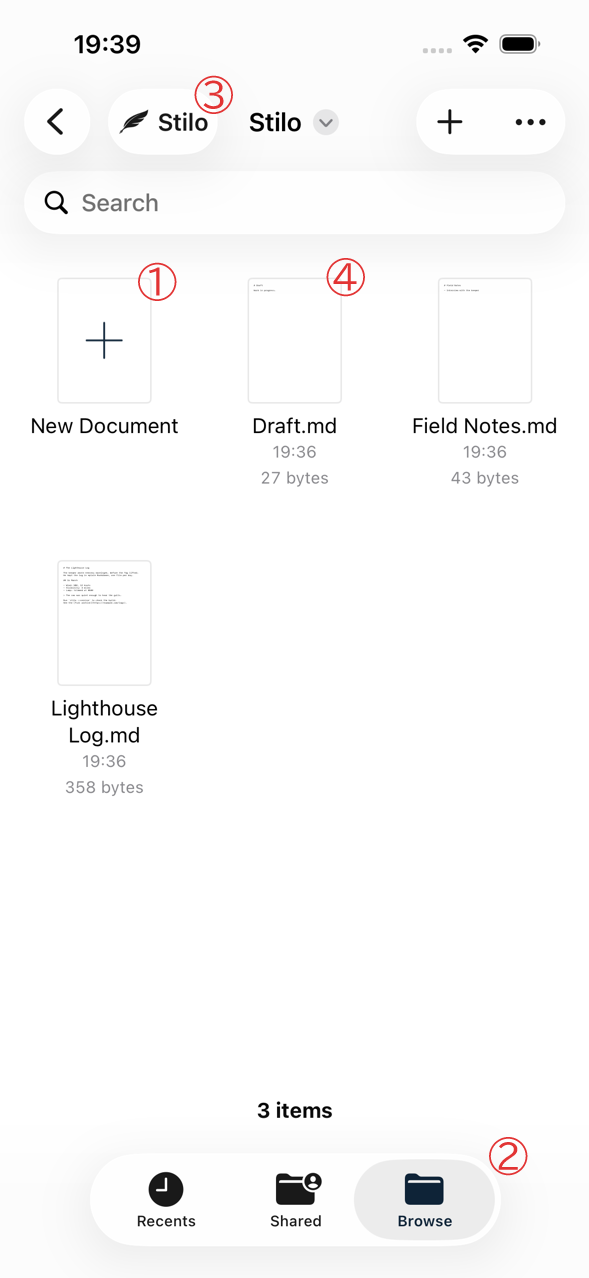
- ① New Document
- A tile near the top left. It creates an empty
.mdfile, asks where to keep it, and opens the editor. The first name is “Untitled.md”; iOS adds a number if that name is taken. - ② Browse / Recents
- The tabs along the bottom. Use Browse to walk through your storage locations, and Recents to return to a document you had open.
- ③ The feather and Stilo mark
- The brand mark at the top left, there so you can tell this screen apart from the Files app. Tapping it does nothing. It appears once you open a storage location and in Recents; on the very first list screen iOS does not display it.
- ④ Tapping a document
- Opens the editor. A document in iCloud that has not been downloaded yet shows its download progress first.
- Renaming
- Touch and hold a document for a menu with Copy, Move, Share, Rename, Duplicate, Delete and more. Rename changes the name. You can also do it from the editor; see Renaming a file.
Choosing “Open in Stilo” from another app's share sheet opens the same editor.
3. The editor
Opening a document brings you to the editor. From top to bottom: the navigation bar, the body text, the status line and, when the keyboard is up, the tag toolbar.
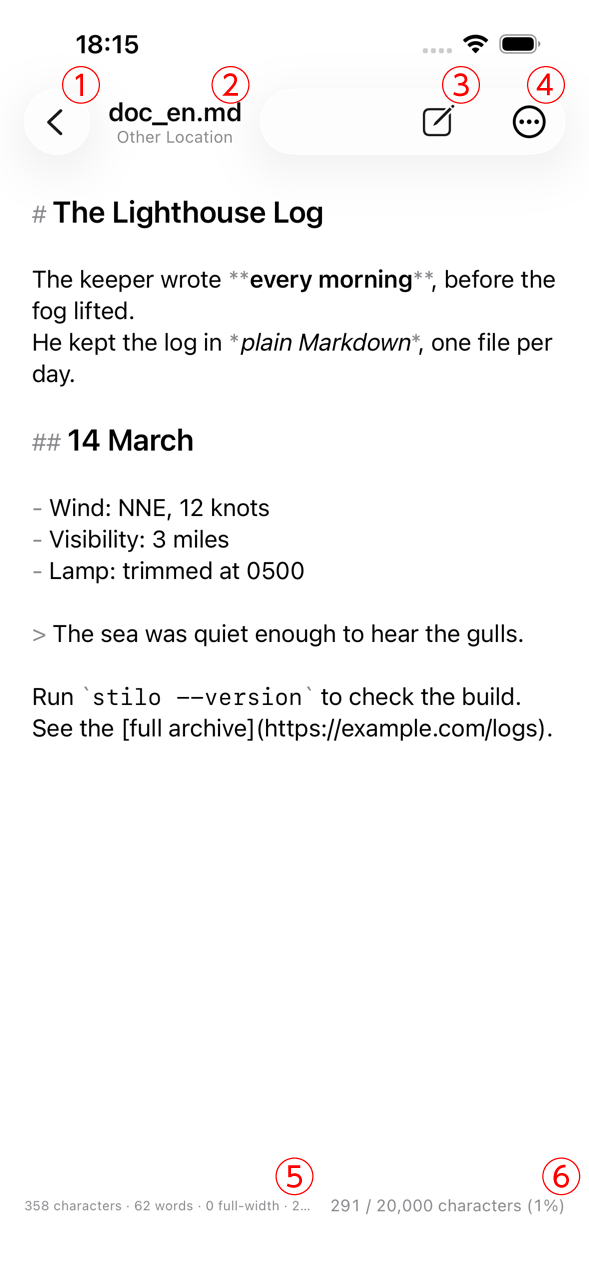
Navigation bar (top)
- ① ‹ Files (far left)
- Saves the document, closes it and returns to the file list. Unsaved changes are written before closing.
- ② File name and location (centre, two lines)
- The upper line is the file being edited; the smaller line below is where it lives. You will see “iCloud Drive”, “On My iPhone” or “Other Location”. Cloud services other than iCloud Drive and on-device storage all read “Other Location”, because iOS does not tell apps the name of the service. Tap here to rename the file, as described next.
- ③ View mode (right, an icon menu)
- Switches between Edit, Preview and Split. The icon shows the current mode: a square with a pencil for Edit, an eye for Preview, a divided rectangle for Split. Split works only where there is room, so on a narrow iPhone it falls back to Edit.
- ④ … (far right, the More menu)
- Contains Find and Replace, Larger Text, Smaller Text, Default Size, Edit Tag Toolbar, Export HTML, Export PDF and Settings.
- Share icon (Preview only)
- A square with an upward arrow. It appears only while you are previewing and opens the HTML and PDF export menu.
Text size here is separate from the system setting and applies only inside Stilo. It moves in steps of 10% between 70% and 200%, and Default Size returns it to 100%.
The body text and how markup looks
Stilo leaves what you typed exactly as you typed it. It never hides or replaces markup. Instead it dims the markup characters so the prose stands out.
- Headings
- The
#and##markers go grey while the heading itself becomes larger and bold. - Bold and italic
- In
**bold**the surrounding**dims and the text inside turns bold.*italic*behaves the same way. - Code
- Text inside
`backticks`is shown in a monospaced face. - Lists, quotes and rules
- Line-leading
-,1.,>and---are dimmed. - Ruby notation
- In
|北海道《ほっかいどう》the|,《and》dim and the reading is shown smaller. It only rises above the base text as real ruby in the preview.
Status line (bottom)
- ⑤ Counts on the left
- Reads like “1,248 characters (1,203 excluding spaces)”. With “Show full/half-width counts” on, it continues “· 1,100 full-width · 103 half-width”. When your page unit counts words, it shows characters and words instead. Tap it to open the detailed statistics.
- ⑥ Page count on the right
- Shows the figure in the unit you chose, such as “3.2 pages”. With a goal set, it shows your progress instead, like “12,300 / 20,000 characters (62%)”. This is a Stilo Pro feature; without it the figure still appears, carrying an orange PRO badge, and tapping opens the purchase screen.
- While previewing
- The line changes. In horizontal writing the right side reads “Ruby on” or “Ruby off”. In vertical writing the left reads “← Scroll right to left” and the right reads “Tate-chu-yoko on” or “off”.
Renaming a file
Tap the file name in the centre of the navigation bar and a rename screen slides up. New documents are created as “Untitled.md”, so this is where you give a piece of writing its name once you have started.
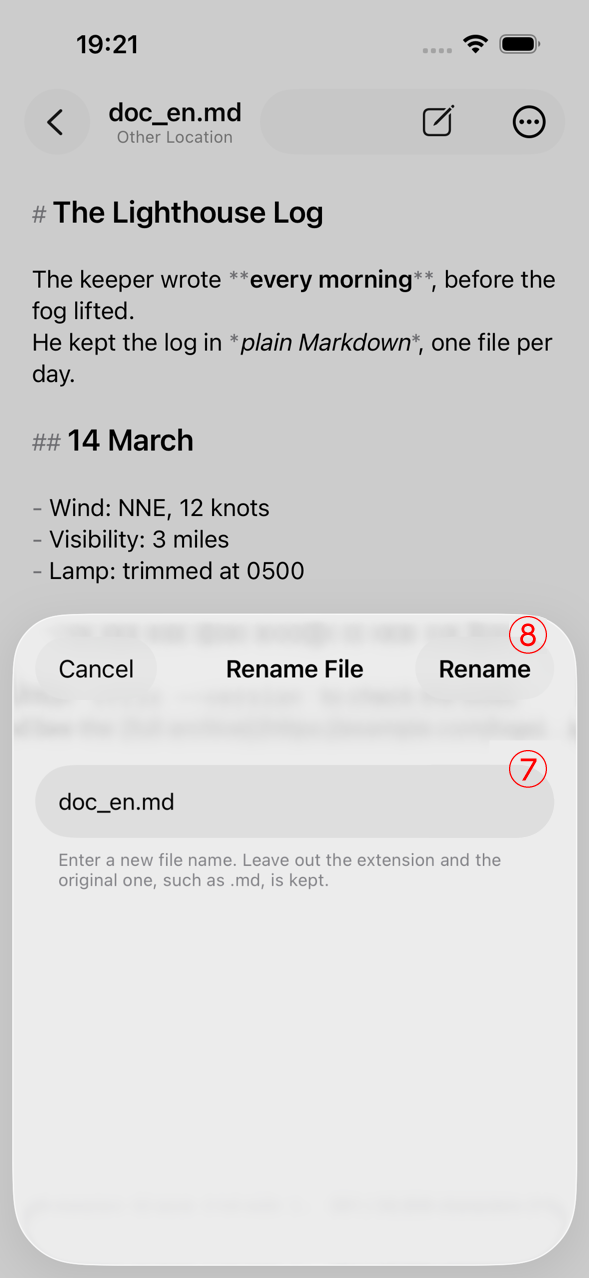
- ⑦ The text field
- Starts with the current file name. Edit it and tap Rename. Leave out the extension, such as
.md, and the original one is kept; type a different extension and that is used instead. - ⑧ Rename
- Applies the new name. Any unsaved text is written first, then the file is moved. Your text and undo history are untouched.
A name is refused if it contains “/”, starts with a dot, or matches a file that already exists. The reason appears below the field. When the location is read-only, tapping the file name does nothing.
The same thing is possible from the document browser: touch and hold, then Rename.
4. The keyboard toolbar (tags)
Tapping the body raises the keyboard and a row of buttons just above it, for inserting frequently used markup in one tap. The left portion scrolls sideways.

- ① Tag buttons (left)
- By default:
#,##,B,I,・,「」,|《》,──,`and[](). With text selected, the button wraps the selection; with nothing selected it inserts the markers and puts the cursor between them. You can change the set under Editing the tag toolbar. - ② |《》 (ruby notation)
- This one behaves slightly differently. Select the base text and tap it to get
|北海道《》, with the cursor inside《》ready for the reading. Tap it with nothing selected to get|《》, with the cursor just after|ready for the base text. If your selection spans a line break, nothing happens. This button is free to use. - ③ Undo (right, arrow curving left)
- Reverses your last edit. An insertion from a tag button is undone in a single step.
- ④ Redo (right, arrow curving right)
- Reapplies what you undid.
- ⑤ Dismiss keyboard (far right)
- Puts the keyboard away. Swiping down over the text does the same.
5. Find and replace
Choose Find and Replace from the … menu and a search bar appears above the text.
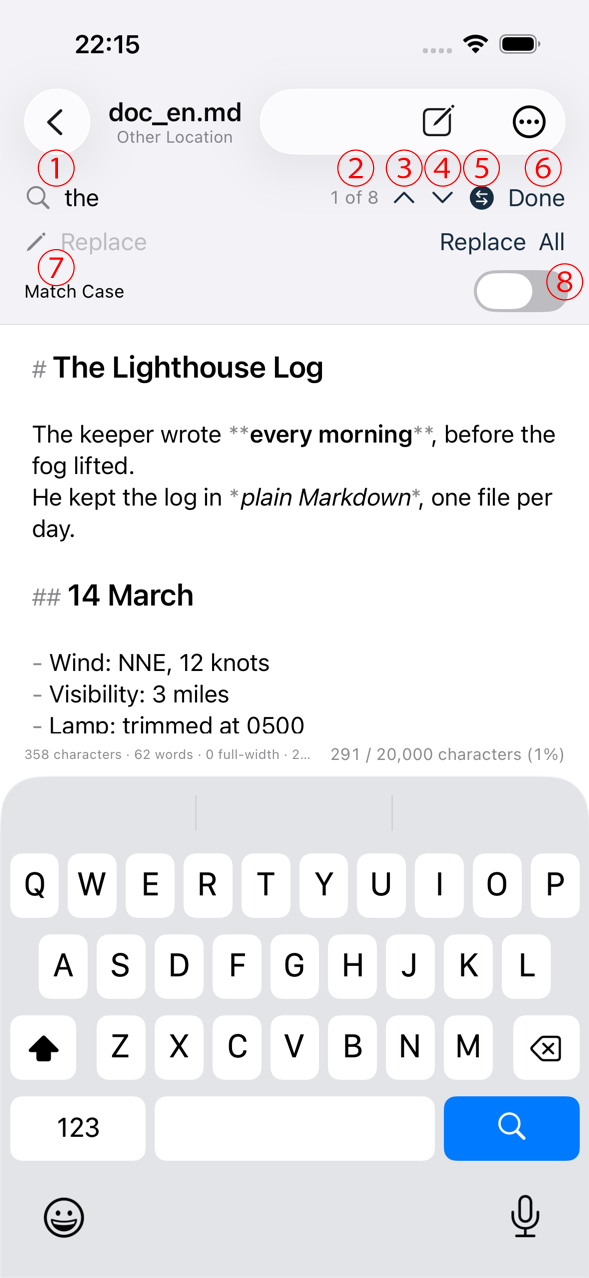
- ① Magnifier and search field
- Type what you are looking for. Matches are recounted as you type and the first one is selected.
- ② Match count
- Shows your position and the total, like “1 of 5”, or “0 matches” when nothing is found.
- ③ ∧ previous
- Moves to the previous match, wrapping to the end from the first.
- ④ ∨ next
- Moves to the next match, wrapping to the start from the last.
- ⑤ Replace toggle (two arrows in a circle)
- Shows and hides the replace field.
- ⑥ Done
- Closes the bar and clears the search term.
- ⑦ Replace field (the row with the pencil)
- Type the replacement. “Replace” changes the current match; “All” changes every match. Even a replace-all is undone in a single step.
- ⑧ Match Case
- With this off,
Stiloandstiloare treated as the same word.
6. Preview
Choosing Preview shows your Markdown typeset. It is read-only. Split places the editor on the left and the preview on the right.
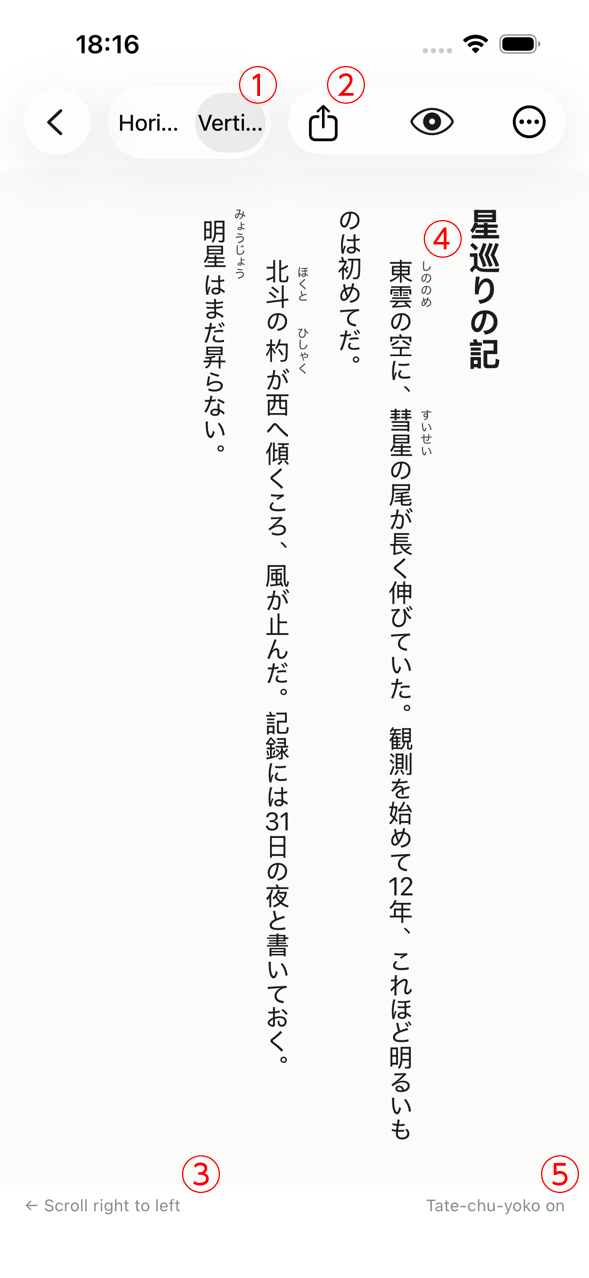
- ① Horizontal / Vertical (centre of the navigation bar)
- Switches the writing direction. Vertical is a Stilo Pro feature: without it, choosing Vertical opens the purchase screen and the view stays horizontal.
- ② Share (export)
- A square with an upward arrow. It opens the HTML and PDF export menu; see Exporting.
- ③ The body, read vertically
- The text begins at the right edge and runs leftwards, so scroll from right to left as you read. Tables, code blocks and images become unreadable when rotated, so those blocks keep their horizontal layout.
- ④ Ruby
- With “Convert ruby notation” on and Stilo Pro active,
|北海道《ほっかいどう》appears as ruby text above the base characters, or to their right in vertical writing. Otherwise the notation is shown as written. - ⑤ Tate-chu-yoko
- Half-width characters rotate in vertical writing. Tate-chu-yoko keeps two-digit numbers upright. Longer numbers and Latin words stay rotated; full-width digits such as 12 stay upright at any length.
- Links
- Tapping a link opens it in your default browser rather than inside Stilo.
7. Statistics
Tap the counts in the status line to open this sheet.
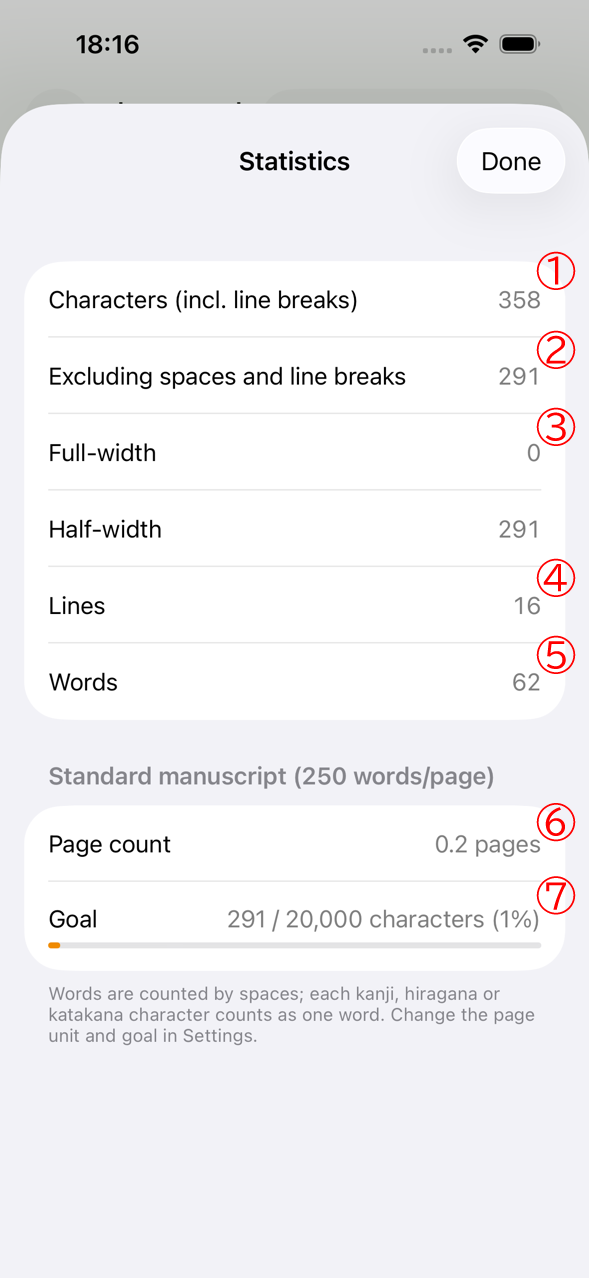
- ① Characters (incl. line breaks)
- Every character in the document, counting each line break as one. Emoji and combining sequences count as the single character you see.
- ② Excluding spaces and line breaks
- The same count with whitespace removed.
- ③ Full-width / Half-width
- A breakdown of the characters excluding whitespace. Kanji, kana and full-width punctuation are full-width; Latin letters, digits and ASCII punctuation are half-width.
- ④ Lines
- The number of lines separated by line breaks.
- ⑤ Words
- Tokens separated by spaces, plus each kanji, hiragana and katakana character counted as one word. Languages that space their words, such as Korean, are counted by spaces alone.
- ⑥ Page count (Stilo Pro)
- The figure in your chosen unit. For manuscript sheets, each paragraph consumes as many lines as it needs and a blank line counts as one line.
- ⑦ Goal (Stilo Pro)
- Your progress towards the goal, as a figure and a bar.
8. Exporting (HTML and PDF)
Export from the share icon while previewing, or from the … menu. The file is handed to the iOS share sheet, so you can save it to Files or send it by mail or message.
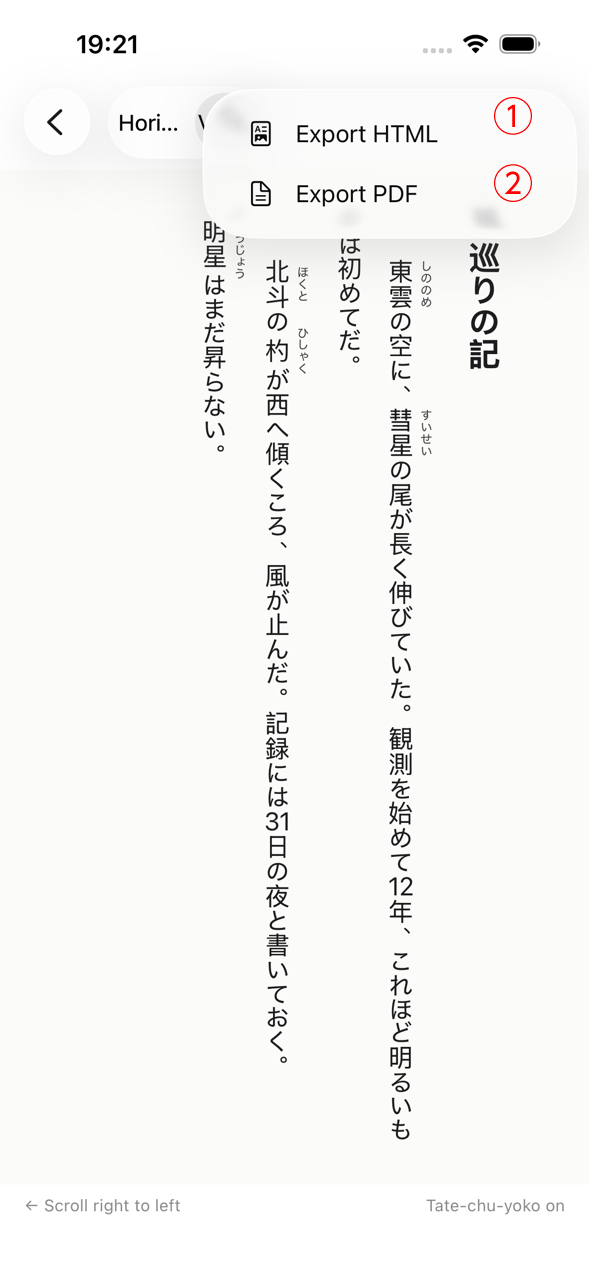
- ① Export HTML (free)
- Writes a single HTML file that looks like the preview. The styling is inside the file, so it looks the same wherever it is opened. On the free version ruby notation and vertical writing are not applied and the notation remains as written. That is intended.
- ② Export PDF (Stilo Pro)
- Produces a PDF with the same typesetting as the preview, vertical text and ruby included. Without Pro the menu item carries a lock and a PRO badge, and tapping opens the purchase screen.
- Paper size and orientation
- Choose A4, Letter or Legal under Settings → Export. The default follows your region, so it is Letter in North America. Orientation follows the text: vertical writing is exported on the same paper turned landscape.
- File name
- The name of the document without its extension, plus
.htmlor.pdf. - Font licence reminder
- Exporting a PDF while using an imported font shows a licence reminder once, because the font is embedded in the PDF. Choosing “Export and Don't Show Again” stops it appearing in future.
9. Settings
Open Settings from the … menu. The sections are described here in the order they appear.
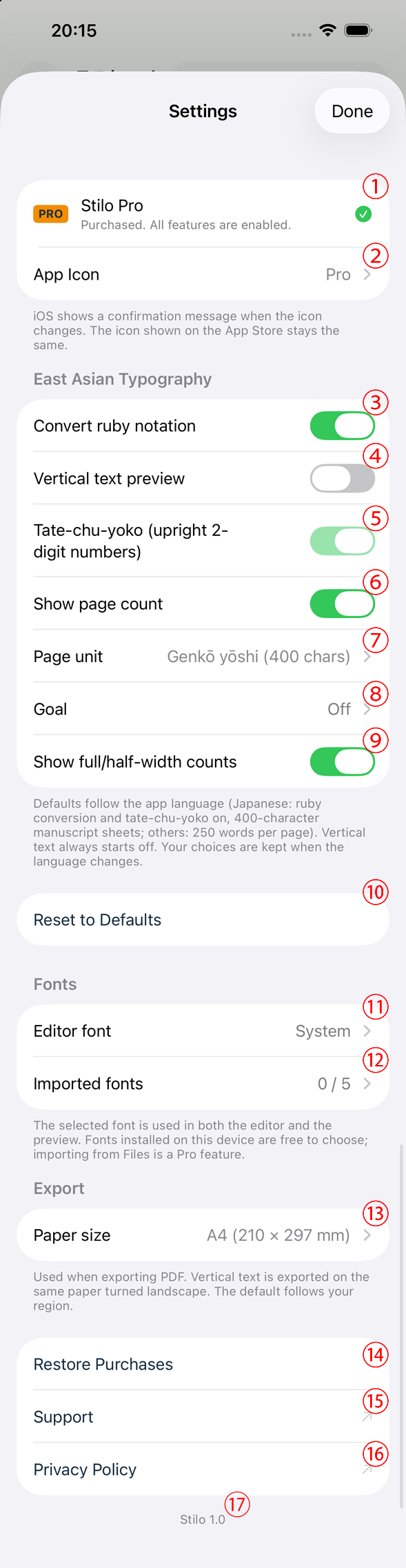
Stilo Pro
- ① The first row
- Once purchased it reads “Stilo Pro / Purchased. All features are enabled.” with a green check. Before purchase it reads “About Stilo Pro / One-time purchase. Not a subscription.” and opens the purchase screen.
- ② App Icon (Stilo Pro)
- Choose between the Standard and Pro home screen icons. On the Pro icon the nib and the shaft running up through the feather are orange. iOS always shows a confirmation message when the icon changes; that is iOS behaviour and cannot be suppressed. The icon shown on the App Store does not change. Without Pro the row carries a lock and a PRO badge.
East Asian Typography
The defaults here are decided by the app language the first time you launch Stilo: ruby conversion and tate-chu-yoko start on in Japanese and off elsewhere. After that, your choices are kept even if you change the language.
- ③ Convert ruby notation (Stilo Pro)
- Renders
|base《reading》as ruby text in the preview. The text in the editor is untouched. - ④ Vertical text preview (Stilo Pro)
- Sets the preview in vertical columns. It starts off even in Japanese, because turning it on changes the view dramatically and it is better switched on deliberately.
- ⑤ Tate-chu-yoko (upright 2-digit numbers) (Stilo Pro)
- Keeps two-digit numbers upright in vertical writing. The row is greyed out while vertical preview is off.
- ⑥ Show page count (Stilo Pro)
- Whether the page figure appears on the right of the status line.
- ⑦ Page unit (Stilo Pro)
- Choose 250 words per page, 400- or 200-character Japanese manuscript sheets, 600-character Taiwanese gaozhi, 200-character Korean wongoji, or Custom. Custom lets you count by characters or words and set your own characters per line and lines per page, or a total per page.
- ⑧ Goal (Stilo Pro)
- Set a target in characters, words or pages. Entering 0 turns it off.
- ⑨ Show full/half-width counts (free)
- Whether the status line adds the full-width and half-width breakdown.
- ⑩ Reset to Defaults
- Recalculates this section from your current app language. Any goal is cleared.
Fonts
- ⑪ Editor font
- The font used in both the editor and the preview. Choose System, a font already installed on the device, or one you imported. Choosing among the device's fonts is free. If the chosen font cannot be found, a warning triangle appears and the system font is used.
- ⑫ Imported fonts (Stilo Pro)
- Shows how many you have imported against the limit, such as “2 / 5”. Tap to open the list.
On that list you can do the following.
- Import Font…
- Pick a
.ttf,.otfor.ttcfrom Files. The file is copied into the app and detached from the original, so moving or deleting the original does not break it..woffand.woff2are web-only formats iOS cannot use, and are declined with an explanation. A.ttcholding several faces asks which one to use. - The “No vertical glyphs” label
- Means the font has no glyph forms for vertical writing, so punctuation and brackets will face the wrong way in vertical mode. The font is fine horizontally.
- The “Can't load” label
- The file could not be read, for instance because it is damaged. The app carries on and falls back to the system font.
- Deleting
- Swipe the row left. The copied file is removed and any setting using that font returns to System.
- The licence note
- Always shown at the bottom of the screen. Please check each font's licence yourself, including whether it may be embedded in PDFs. Stilo does not distribute fonts.
Export
- ⑬ Paper size
- The paper used for PDF: A4 (210 × 297 mm), Letter (8.5 × 11 in) or Legal (8.5 × 14 in).
The last group
- ⑭ Restore Purchases
- Brings back your purchase after changing devices or reinstalling. You need to be signed in with the Apple Account you bought with.
- ⑮ Support
- Opens the support page on this site in your browser.
- ⑯ Privacy Policy
- Opens in your browser as well.
- ⑰ Version
- Shown at the very bottom, like “Stilo 1.0”. Please include this number when reporting a problem.
10. Editing the tag toolbar
Open Edit Tag Toolbar from the … menu to reshape the row of buttons above the keyboard to suit how you write.
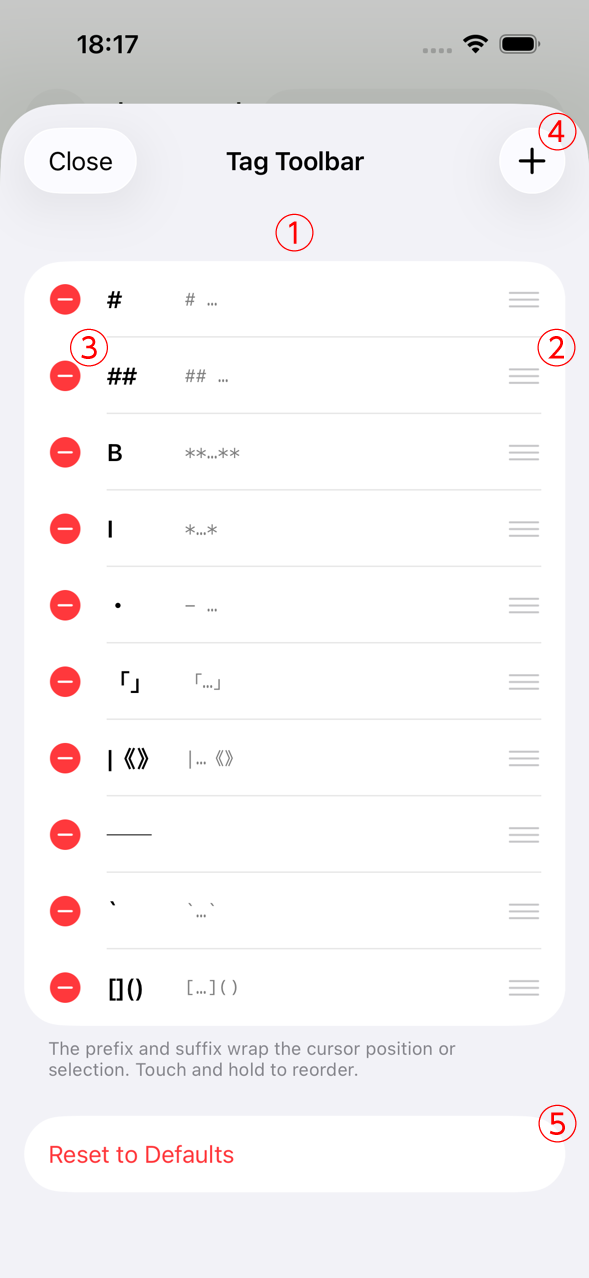
- ① The list
- Each row shows the button's label and what it inserts, written as the prefix and suffix joined by
…, for example**…**. - ② Reordering
- Press and hold the three lines at the right of a row and drag it.
- ③ Deleting
- Swipe the row left.
- ④ + (top right)
- Adds a new button.
- Tapping a row
- Edits that button.
- Fields in the edit sheet
- “Label” is the text on the button; shorter labels are easier to hit. “Prefix” goes before the selection and “Suffix” after it. Leave the suffix empty to insert only the prefix, which is how
#for headings and-for lists work. “Place Cursor Inside the Wrap” puts the cursor between the two after inserting. - ⑤ Reset to Defaults
- Restores the original ten buttons, after a confirmation.
11. The Stilo Pro screen
This appears when you tap a Pro feature, or from “About Stilo Pro” in Settings. It never appears merely because you launched the app.

- ① × (top right)
- Closes the screen. Nothing is purchased.
- ② Icon and title
- The Pro app icon, the heading “Stilo Pro”, and a single sentence about the thinking behind it.
- ③ Feature list
- The five things Pro adds, each with an icon and one line: vertical text preview, ruby annotation, page counts and writing goals, PDF export, and all themes and fonts.
- ④ Purchase button (in two places)
- Reads “Buy Pro — $0.00 (one-time purchase)” with the price the App Store reports for your country. One sits after the feature list and one after the comparison table; both do the same thing and open the App Store purchase sheet. Both are disabled while a purchase is in progress.
- ⑤ What's in Free vs Pro (the table)
- Lists what the free version does and what Pro adds, row by row, without omitting anything the free version can do. For example it states plainly that ruby will display for free if you write HTML
<ruby>tags yourself. - ⑥ Restore Purchases
- For when you have already bought. Signed in with the same Apple Account, your purchase comes back.
- ⑦ Note and links
- States that one purchase covers every iPhone and iPad on the same Apple Account, followed by links to the terms of use (Apple's standard) and the privacy policy.
- While purchasing
- The button shows a loading indicator while the price is fetched and while the purchase is processed. Where approval is required, such as Family Sharing, it says the purchase is waiting for approval and Pro turns on by itself once approved. Failures show a short message. When the purchase completes, the screen closes and “Stilo Pro is now active” appears once.
12. Resolving a conflict
This screen appears when the same file was edited on two or more devices and the versions diverged. Stilo never picks one for you.
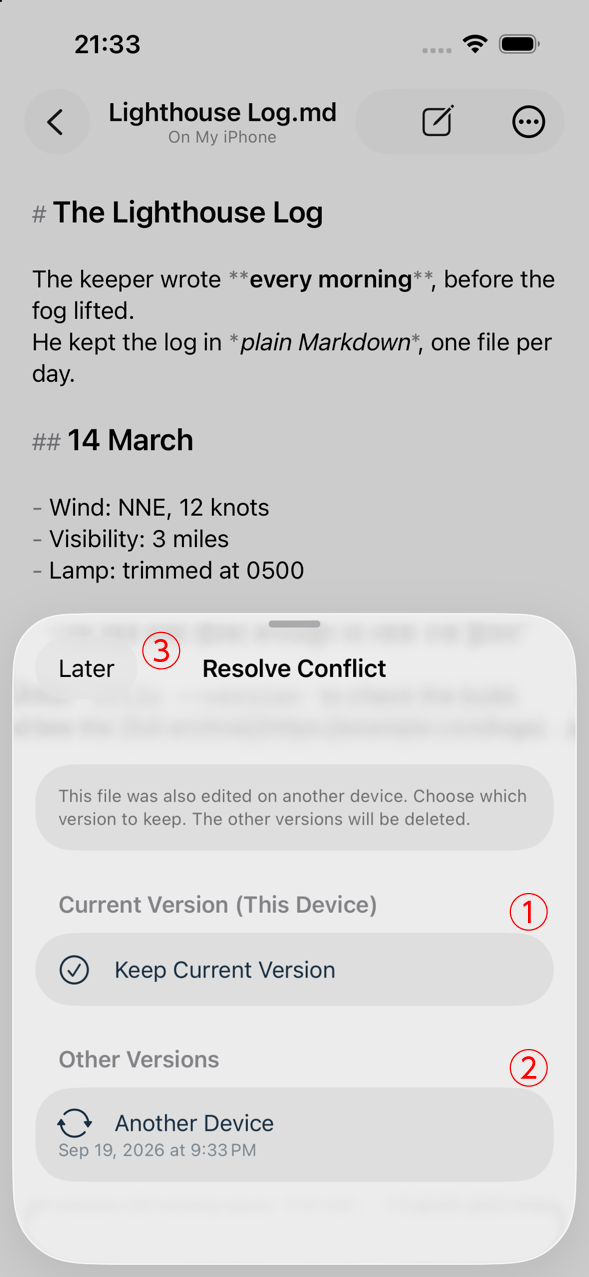
- ① Keep Current Version
- Keeps what you wrote on this device.
- ② Other Versions
- Lists the versions saved elsewhere, with the device name and time where they are known. Where the name is unknown it reads “Another Device”. Tap one to adopt it.
- ③ Later
- Closes without deciding. The screen returns next time you open the file.
Versions you do not choose are deleted. To keep more than one, choose Later and duplicate the file in the Files app before deciding.
13. The read-only banner
When the location turns out to be unwritable, a lock icon and a message appear above the text and editing stops. You can still select and copy. This prevents you from losing work by writing into a place that cannot be saved.
Note that in some cases, such as OneDrive under an organization's policy, iOS does not tell the app that the location is read-only. The banner then does not appear and text you believed saved may disappear later. See Support for details.
Still stuck?
Support collects the common questions. If that does not help, write to admin@stilo.osprey74.com.